
Updated on 4th November 2024
My critiques of Rational Emotive Behaviour Therapy (REBT)
By Dr Jim Byrne
This page was originally dedicated to a single book title, but this has now been expanded to four books as below:
~~~
A Major Critique of REBT: Revealing the many errors in the foundations of Rational Emotive Behaviour Therapy.
 This new (2019) book is an improvement on the original (2017) book, for three main reasons:
Firstly, the reason CBT was included in the title was that all systems of CBT, with which I am familiar, are based on the ABC model, as is REBT; and the 2017 book contained a detailed critique of the ABC model. However, the substance of the 2017 book was about Albert Ellis’s system of REBT, based on his way of presenting and using the ABC model. So, in the second version, CBT is not mentioned in the title.
Secondly, there was a need to clarify the bottom line of my critique of REBT, and that has been done in a 16 page Preface to the reissued, 2019 edition.
And, thirdly, I have also added a reference to the research which shows that emotional pain and physical pain are both mediated and processed through significantly overlapping neural networks, which contradicts Dr Ellis’s claim that nobody could hurt you, except with a baseball bat. Emotional pain hurts just as significantly as physical pain, and it’s not okay for therapists to ignore the emotional pain of their clients. (This point had not been made, with scientific evidence, in the 2017 edition).
Apart from these changes, the 2019 version of this major critique of REBT is identical to the 2017 version. For more details about the contents of the 2019 reissued and updated version, please click this link: A Major Critique of REBT.***
Here is the Preface to the latest (2019) edition:
Preface to the 2019 Reissued Edition
By Dr Jim Byrne
~~~
Background
This book was originally published with a more negative, damning title. The text analyses, critiques, and totally dismantles the ABC(DE) model of Rational Emotive Behaviour Therapy (REBT), (which is also sometimes called Rational Emotive and Cognitive Behavioural Therapy [RE&CBT].)
I wrote and published Part One of this book in 2017.
Part One is a critique of the essence of REBT, as it was written about and spoken about by Dr Albert Ellis and his close follows. It dismantles the entire core of the theory of REBT.
Nothing is left of the ABC(DE) model, as such. Of course, REBT was constructed from a number of strands of philosophy, plus some behaviour therapy, and cognitive psychology. The main elements which have been demolished by this book are:
The ABC(DE) model; and:
The extreme elements of Stoic philosophy.
Those elements of moderate Buddhism and moderate Stoicism, which were built into REBT theory have not been invalidated; and indeed they are seen as extremely valuable aspects of a philosophy of sanity in an insane world.
~~~
Then I decided to add Part Two, which is a set of ‘historical documents’ – or documents which went into the building of my journey away from REBT, towards the creation of a whole new theory of human disturbance.
The substance of Part Two consists of Chapters 7 to 14 of this book; almost all of which were originally published as free-standing papers, between 2009 and 2014 (apart from Chapter 7, which was written in 2003). (There is also an Introduction to Part Two, plus Reflections upon Part Two; both of which were written in 2017).
This structure of the book, with the earlier-written papers appearing after the later-written critique, may be confusing for some people, who then want to know: What is the bottom line of my critique? I will answer that question below.
~~~
In the Preface to the original (2017) edition of this book, we wrote this:
Who is this book for?
If you are a student, practitioner or fan of Rational Emotive Behaviour Therapy (REBT), or of more general Cognitive Behaviour Therapy (CBT), then this book will be of interest to you. (However, I should have clarified that this book is a deeply critical analysis of the substantial foundation of Rational Emotive Behaviour Therapy).
You could also be interested in the content of this book because you want to understand the ABC model, which underpins virtually all forms of Cognitive Behavioural Therapy (CBT). (Again, I should have added that we reject the ABC model of REBT, and replace it with our own Holistic Stimulus-Organism-Response (SOR) model, in which diet, exercise, sleep, current relationships, family of origin, attachment style, personality adaptations, and many other issues are seen to be on a par with – and sometimes more important than – and sometimes a determinant of – a person’s belief system or philosophy of life).
Or – (I suggested, in the 2017 Preface) – you might be interested in Stoic philosophy, and intrigued by the idea of my distinction between ‘extreme Stoicism’ and ‘moderate Stoicism’.
Or you might be interested in what this book has contributed to improving the philosophy of counselling and psychotherapy in general, and particularly the understanding of the whole body-brain-mind-environment-complexity which is the sum-total of a counselling client’s being.
The function of this new (2019) Preface is to clarify a couple of questions that have arisen for at least one reader of this book (and no doubt many others besides).
~~~
The questions
On 11th January 2019, I received an email from a reader of some of my books, including this book on REBT.
The author of that email – who, for convenience, I will refer to as MM – had two questions to ask, for the purpose of clarifying some aspects of this book.
(a) MM’s first question:
The first question was this:
(1) What part of REBT do you still find useful in your work, and where would I find it in one of your books.
I think it is true to say that the only part of REBT, as such, that I still find helpful in my work is Rational Emotive Imagery (REI) – which Albert Ellis borrowed from Maxie Maultsby. And I still use this in very much the way Albert Ellis used it – with one notable difference.
However, I use it as just one-third of my own process of desensitization of individuals to traumatic stress triggers. In Appendix ‘F’ of my book on Facing and Defeating Your Emotional Dragons (2019)[1], and also in Appendix ‘C’ of my Holistic Counselling in Practice (2016 and 2019)[2], I presented my full desensitization process, including my approach to REI.
The other two processes that I use for desensitization are:
# Progressive relaxation; and
# The Havening technique (which is a combination of self-soothing and eye-movement desensitization).
Let me present my take on REI here, and then I will explain my point of departure from Dr Albert Ellis.
Rational Emotive Imagery (REI)
Using the power of imagination, REI can prepare individuals to deal with situations they would rather avoid because of anxiety or panic. The procedural steps, with comments upon each step, are as follows, using the example of a (wo)man checking into hospital for some medical procedures, and feeling anxious and panicky (because this person has had some traumatic experiences of hospital in the past):
| Procedure | Comments |
| 1. Ask the client to imagine, vividly and clearly, the event or situation with which s/he has problems. | In our example: Checking into hospital, and giving up their clothing to a nurse. |
| 2. Tell them to allow themselves to feel – strongly – the disturbing emotion which follows from this visualization. “Really get in touch with it. Feel it fully!” | They will tend to respond, as is their normal response, with anxious feelings. |
| …continued on next page… |
| 3. Tell them: “Now, without changing anything in the situation – you are still checking into hospital (which is a particular challenge for you) – change how you feel. Reduce your feeling to a low level of anxiety or concern. And let me know when you have achieved that!” | S/He will go through some kind of struggle to reduce his/her feelings of anxiety. S/He will not be absolutely clear what s/he is doing – meaning, ‘where the controls are’ – but s/he will normally succeed. (We can, it seems, decide to ‘regulate our affects’! [But this may also be a function of ‘external affect regulation’, because of the external voice of direction from the therapist!]) |
| 4. When they nod or confirm that they have achieved their aim, tell them: “Now open your eyes. How did you reduce the feeling? What did you change?” | If you have taught them the Six Windows model (as in Appendix B, below), they may tell you they used one or more of the Six Windows (as a means of re-framing the stimulus); or they may have simply decided to tough it out; or they may have given up trying to be in control. (But bear in mind that they have a capacity to make up stories to describe what they think has gone on inside of their mind – but that the story is just a story. [Maier, 1931]). |
| 5. Finally, tell them: “Practice this visualization technique (REI) daily for a while – at least ten to thirty days – until it becomes second nature to you”. | It can be helpful to ask them to set up a system of rewards and penalties for doing their REI visualization every day; otherwise they may fail to do it! |
~~~
Please note that the way I differ from Albert Ellis here is this: I do not go hunting for the ‘belief’ that the client is assumed to have changed.
Why not?
Because in (my) E-CENT counselling theory:
- The client is assumed to be a largely non-conscious, habit-based being; and:
- We do not take the view that their beliefs cause their feelings.
- We do not think it is possible to distinguish, in practice, between thoughts, feelings and beliefs/ perceptions. Instead, we believe that individuals ‘perfink’ – or perceive/feel/think – all in one grasp of the mind. Thus we do not fetishize the idea that the client can find the ‘belief’ that they ‘changed’ in order to change a feeling.
- We reject the ABC model, and substitute the Holistic S-O-R model, which is shown and discussed later, below.
- As early as August 2003 (and probably earlier), I was writing about the fact that stress was a multi-causal problem. That idea contradicts the ABC theory, which asserts that all emotional distress (including the common manifestations of stress: which include anger, anxiety and depression) are caused exclusively by the client’s Beliefs (B’s) – or, sometimes, caused exclusively by the client’s Beliefs (B’s) about their noxious Experiences (or A’s [Activating events]). Here is an example of my writing from August 2003:
“I have developed a stress management programme consisting of fifteen strategies which help you to work on your body, your emotions, your thinking, (your environmental stressors), and your stress management skills. This programme allows you to develop a stress-free life.” And this involved diet, exercise, sleep, relaxation, meditation, time management, philosophy of life, and much more besides.
~~~
- In Albert Ellis’s books, an exaggerated claim is presented to the effect that REBT could help the reader to fairly quickly and relatively effortlessly get rid of any problem, simply by changing their beliefs about the problems they encountered.
In this current book, below, I present an illustration of the fact that there never was any solid evidence that this claim is true. (See the case study of Albert Ellis working with a man who is distressed by his golfing peers discounting him, in Chapter 2, below).
I also demonstrate that, in the process of ‘disputing irrational beliefs’, the REBT model blames the client for their own upsets, thus excusing the harshness of current government policy in the US and the UK, where the rich are enriched and the poor are squashed! That squashing process hurts – (see Eisenberger, et.al. 2003) – and causes emotional distress and physical health problems (which REBT tries to deny and thereby effectively whitewash!)
- Here is the raw evidence that it is not the individual’s beliefs, but the social-economic environment that has the most impact on mental health and emotional well-being:
While psychotherapists like Albert Ellis tended to emphasize the role of the counselling client’s beliefs in the causation of anger, anxiety, depression, and so on, Oliver James, and his concept of ‘affluenza’, tends to emphasize living in a materialistic environment. As Dr James writes: “Nearly ten years ago, in my book Britain on the Couch, I pointed out that a twenty-five-year-old American is (depending on which studies you believe) between three and ten times more likely to be suffering depression today than in 1950. … In the case of British people, nearly one-quarter suffered from emotional distress … in the past twelve months, and there is strong evidence that a further one-quarter of us are on the verge thereof. … (M)uch of this increase in angst occurred after the 1970s and in English-speaking nations”. People’s beliefs have not changed so much over that time. This is evidence of the social-economic impact of the post-Thatcher/Reagan neo-liberal economic policies!
Oliver James (2007) Affluenza: How to be successful and stay sane. Page xvi-xvii.
~~~
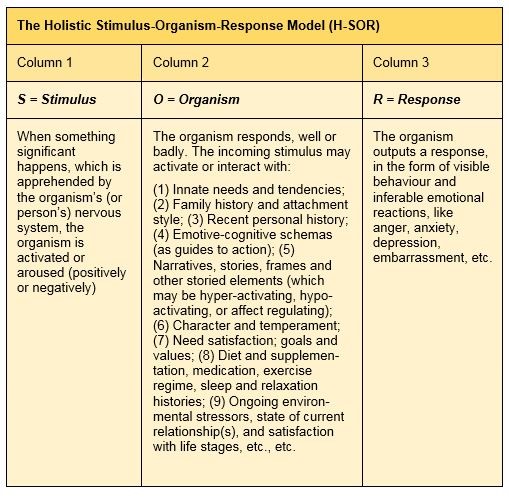
- And now, here is our Holistic-SOR model – where S = Stimulus; O = Organism (or person); and R = Response (emotional and/or behavioural, made by the organism or person), which is strongly affected by the factors listed in Column 2: including diet, exercise, sleep, etc.
~~~
(b) MM’s second question:
The second question was difficult for me to decipher, so I asked my reader to clarify their question further. MM sent a revised statement of the meaning of the second question, which I hope I have summarized correctly as follows:
Question 2(a): “What do you (JB) see as the main attributes of the ‘B’? (You mention Awfulizing, Demandingness, Frustration Tolerance, and Condemning and Damning)”.
As mentioned above, we reject the ABC model, and substitute the Holistic S-O-R model. Thus, for us, the Belief System, outlined in REBT, is not valid. So, instead of looking at ‘the main attributes of the B (or Belief system)’, we would tend to talk about the state of the human organism, resulting from the whole range of factors mentioned in column 2 of the Holistic S-O-R model, shown above.
Let me explain why, in some detail, we see the REBT list of ‘irrational beliefs’ as being invalid:
(i) Demandingness
We no longer accept the validity of the concepts of ‘demandingness’ and ‘musturbation’, for the following reasons:
- Since the time of the Buddha it has been postulated that human beings become upset when their desires are thwarted. And desires can be preferential wishes, or unrealistic expectations, or dictatorial commands. As the Buddha is said to have claimed: “One hair’s breadth difference between what you want, and what you’ve got, and heaven and earth are set apart”. So teaching people that they only need to get rid of demands and musts is misleading. They need to watch what they desire; and they need to keep their expectations in line with reality (to the degree that anybody can determine what ‘reality’ is!)
- Secondly, one of the unfortunate side-effects of the REBT obsession with commands and demands is this: Individual REBTers come to believe that they can never use the words: should, must, have to, ought to, got to, or need to; in case they are found guilty of ‘musturbation’ and ‘demandingness’. And thus they find that, when necessary, they cannot make moral prescriptions or proscriptions, because all moral prescriptions and proscriptions – (in deontology [or duty ethics] and in rule utilitarianism) – depend upon the use of words like should, must and have to, etc.
- We retain the idea that a person can (and often may) cause problems for themselves by exaggerating their need for something to be in their life; or the need to get it out of their life. We address that tendency towards exaggeration through Window No.2 of our Six Windows Model: (See Appendix B, below). This is the essence of Window No.2:
“Life is much less difficult if you avoid picking and choosing unrealistically. (Choosing what does not exist causes most difficulties in life!)”
There is clearly no need to invoke the concepts of demandingness or musturbation in order to draw the client’s attention to the fact that ‘choosing unrealistically or unreasonably’ is going to produce emotional upsets in their body-mind when those things that are unrealistically chosen cannot be obtained or achieved or retained.
~~~
(ii) We reject the REBT approach to ‘awfulizing’.
- Albert Ellis redefined the word ‘awful’ to mean “more than bad; badder than bad; and badder than it should be, which normally means more than 100% bad, which nothing can be!”
But this is not the common dictionary definition of awful, which is this: “Very bad, or very unpleasant”, which many things can be, and often are!
So, when Albert Ellis was in the process of ‘disputing the client’s Awfuls’, he was whipping them out of their belief that some particular part of their life was “very bad, or very unpleasant”, and into believing that “nothing can be awful”. So, clearly, therapist and client were at cross-purposes. What Ellis was trying to do in those situations, and others, was to persuade the client to become an Extreme Stoic, who cares not one jot for the goodness/pleasantness or badness/unpleasantness of their actual life’s experiences – their objective environmental pressures. Most humans are not up for such Stoic Extremism. Indeed, in the end, it proved impossible for Albert Ellis to walk his own talk – (when he took his colleagues to court to accuse them of Unfair Dismissal – when he himself had always insisted, with his clients, colleagues and students, that nobody should ever object to Unfairness, because Life is Objectively Unfair!)
- We have replaced the concept of ‘awfulizing’ with Window No. 3, which says this:
“Life could always be much worse than it is right now, for you!”
We ask the client to look at their problem as if looking through a window with that slogan written around it, to see how this re-framing changes how the problem shows up for them.
~~~
(iii) Low Frustration Tolerance (LFT).
- Some people are not sufficiently resilient in the face of life’s difficulties. This works against them, because they are crushed by particularly difficult experiences, instead of soldiering on through their difficulties, and coming out the other side.
Because of this problem of low resilience, it is important that counsellors and therapists teach themselves how to promote resilient mental attitudes in their un-resilient clients.
- The main antidote to low frustration tolerance (LFT), or poor resilience, that was taught by Albert Ellis is the idea that, “I certainly can stand (difficult situations)”, and he would have cited examples from the lives of the Stoics, including the willingness of Socrates to die for his principles; or Zeno emerging from his shipwreck and soldiering on; or Albert Ellis’ own general position – when confronted by fearful situations – of affirming, “If I die, I die!”
But most people are not likely to be easily persuaded to adopt such an extreme Stoic or Buddhist principle. (Interestingly enough, the statement, ‘If I die, I die’, is an almost verbatim copy of a statement from the Book of Ruth, which Ellis would have encountered in his Orthodox Jewish Saturday School in New York, when he was a youngish child.)
- What Ellis would never have taught to his therapy clients, which we in E-CENT teach, is this: Physical exercise increases resilience: (Ratey and Hagerman, 2009)[3]. Or this: “Sleep is such a powerful source of resilience…”: (Huffington, 2017)[4].
In this book, below, I have suggested that “…perhaps counsellors and therapists should develop a good understanding of modern research on resilience, to pass on to their clients, instead of relying upon a few random quotations from Stoic philosophers”. And, I could have added, Buddhist philosophers, and Jewish philosophers.
The concept of Low Frustration Tolerance is too simplistic, and extreme, to be of interest to most counsellors or their clients. The concept of resilience is a much more rounded concept, which is developed through a broad range of strategies, and not just telling myself, in the face of any difficulty: “I can stand this!”
For example: Southwick and Charney (2012)[5] – two medical doctors – suggest that a useful curriculum for the development of greater resilience would include: Developing optimism (and overcoming learned pessimism); Facing up to our fears (or being courageous); Developing a moral compass (or learning to always do what is the right thing, rather than what is opportunistically advantageous); Developing a spiritual, faith, or community connection that is bigger than the self; Connecting to others for social support; Finding and following resilient role models; Practicing regular physical exercise; Working on brain-mind fitness, including mindfulness and cognitive training (but they overlooked the impact of food and gut flora on the brain-mind, so that needs to be considered also); Developing flexibility in our thinking-feeling-behaviour (including acceptance and reappraisal); Focusing on the meaning of your life, the purpose of your life, and on desired areas of personal growth.
Perhaps a consideration of these ideas could take us beyond the ‘wishful thinking’ about impossible goals set by Zeno, Marcus Aurelius and Epictetus – (and Albert Ellis, and some other CBT theorists).
~~~
(iv) Condemning and damning of self, other people or the world:
Albert Ellis taught his clients, his students, and his readers to adopt his ‘Unconditional Acceptance’ as an antidote to condemning and damning of self, other people or the world. But this is an expression of black and white thinking. Those are the two extremes of a lengthy scale between Total Non-Acceptance, one the one hand, and Total Acceptance, on the other. But the Buddhists teach the importance of the Middle Way between extremes; as did Aristotle, with his principle of the Golden Mean. And there is a good, moderate Stoic position, which we teach, as Window No.5, which is this:
“There are certain things about life that we can control, and certain things we cannot control. (Accept the things you cannot change, and only try to change the rest)”.
But we also teach this principle:
“Do not accept yourself or other people unconditionally. Accept them one-conditionally. And the one condition that you should apply to yourself and other individuals is this:
We must follow the (moral) Golden Rule, as the basis of our moral stance in the world.
If we and all others follow the Golden Rule, and generally act morally, we can, in every other respect, accept ourselves and those others with all our inefficiencies, ineffectiveness, and poor general judgements”.
We could call this one-conditional acceptance, or radical acceptance; but we must never promote the immoral stance of unconditional acceptance.
~~~
Afterthoughts
- In passing, MM indicated that s/he finds the ABC model useful as a quick way of recognizing an aspect of the client’s problem, though the problem is normally more complex than that. However, I cannot agree with this. I think the ABC model is seriously misleading, because it asserts that what intervenes between an experience and our response to that experience is purely and simply a Belief. But actually, what intervenes between an experience and our response to that experience is The Whole of What We Have Become Through a Long History of Experience!
- In passing, MM implied that REBT is located within ‘cognitive science’, and that I have (helpfully) migrated beyond cognitive science. But I think it is a mistake to say that REBT is located within cognitive science. Indeed, Daniel David, a colleague of Albert Ellis, once suggested that REBT should reposition itself to be located centrally within cognitive psychology and cognitive science[6].
The main reasons I say that it is a mistake to see REBT as being located within cognitive science are as follows:
(a) The ABC model is an equation derived from the first century, extreme Stoic philosopher, and former slave, Epictetus. It did not come out of cognitive science. And it cannot be fitted into cognitive science as a significant element or component.
(b) If anybody wanted to apply a pure cognitive science approach to understanding how a counselling client had upset themselves, they would have to consider the following elements:
(i) Attention: To what feature (or features) of their experience does the client pay attention? (And why?) How could they (as creatures of habit) shift their attention to a less distressing aspect of their experience? (And would that be safe and sensible?)
(ii) Perception: What is the client’s perception of their disturbing experience? How are we to understand that perception? And what are some competing perceptions that could be substituted? (What has the client deleted from their experience in order to arrive at this perception? In what way might they have distorted their experience? And what role has their emotional history played in this perception?)
(iii) Memory: What memories, conscious or non-conscious, could account for the client’s attentional focus, and their perceptual understandings? Can they be made conscious, or do they have to be inferred?
(iv) Language: How does the client describe their experience and their responses? And what does that tell us about their linguistic distinctions? What does it tell us about their ability to manage their affects (or emotions)?
And:
(v) Thinking-feeling: Normally, up to very recently, a cognitive scientist would discount feeling/affects entirely. More recently, cognitive psychology has begun to tack feeling/emotion on to the end of their textbooks. But there is considerable research to suggest that we can never think without feeling; never feel without thinking; and never think-feel without perception. So, in reality, a counselling client does not ‘think’. They perceive-feel-think (or ‘perfink’) all in one grasp of the mind.
So, now, ask yourself: Of those five aspects of cognitive science, which elements are normally considered by Albert Ellis and his acolytes? My answer is clear. Almost none! REBT is not about cognitive science. It’s about Extreme Stoic philosophy! (And my system of Emotive-Cognitive Embodied Narrative Therapy is also not about cognitive science; but rather about the whole range of sciences and philosophies implied by considering the contents of Column 2 of our Holistic-SOR model, above).
~~~
Finale
It is clear from the foregoing reflections that we, in E-CENT counselling theory, do not retain very much of REBT, apart from (modified) Rational Emotive Imagery. The other areas of contact between our ideas and the ideas of REBT are based on common roots in Moderate Stoicism and Moderate Buddhism. We reject extreme Stoicism, extreme Buddhism, and Ellisian Rational Therapy (REBT). We reject the simplicity, and misleading nature, of the ABC model; and we substitute our own Holistic Stimulus-Organism-Response model.
We see humans as primarily emotive creatures of habit, who can also think to some limited extent.
Because our clients have bodies, we have to understand the contribution that their diet, exercise, sleep and environmental stressors play in their physical-emotive-cognitive-storied lives.
~~~
I hope this preface helps MM, and anybody else who wants to know the answer to this question: “What is the bottom line of the critique of REBT contained in this book?”
~~~
Jim Byrne, Doctor of Counselling, Hebden Bridge, May 2019
~~~
Contents
Preface to the 2019 Reissued Edition…………………………………………… iii
Summary………………………………………………………………………………… 1
Preface to the first edition……………………………………………………….. 5
Foreword……………………………………………………………………………… 19
PART ONE – A NEW CRITIQUE OF REBT……………………………………………… 31
Chapter 1 – Theories of Human Disturbance……………………………………………………… 31
Chapter 2 – The ABC Model and extreme Stoicism…………………………………………….. 51
Chapter 3 – Comparing the ABC model to the SOR model…………………………………. 89
Chapter 4 – The nature of extreme Stoicism……………………………………………………… 99
Chapter 5 – Understanding Human Emotion………………………………………………….. 119
Chapter 6 – Summary critique of the ABC-D-E model……………………………………… 173
PART TWO – THE HISTORICAL DOCUMENTS……………………………………… 193
Introduction to Part 2………………………………………………………………………………….. 193
Chapter 7 – The Psychological Models Underpinning REBT…………………………….. 199
Chapter 8 – Beyond REBT: The case for moving on………………………………………….. 229
Chapter 9 – Additional Limitations of the ABCs of REBT………………………………….. 253
Chapter 10 – Fairness, Justice and Morality in REBT and E-CENT……………………. 271
Chapter 11 – Self-acceptance, Competence and Morality issues………………………. 317
Chapter 12 – Clarifying my Split from Albert Ellis………………………………………….. 371
Chapter 13 – Some strengths and weaknesses of REBT…………………………………….. 393
Chapter 14 – My final farewell to Dr Albert Ellis………………………………………….. 415
Reflections upon these historical documents…………………………………………………. 427
PART 3 – SUMMARY AND END MATTER…………………………………………… 436
Chapter 15 – Reflective Summation……………………………………………………………….. 436
References…………………………………………………………………………………………………….. 505
APPENDICES…………………………………………………………………………………………………. 525
Appendix A – On the largely non-conscious nature of human beings……………….. 525
Appendix B – The Six Windows Model of E-CENT……………………………………………… 529
Appendix C – The E-CENT Emotional Needs Assessment Checklist…………………….. 539
Index…………………………………………………………………………………………………………….. 545
Footnotes…………………………………………………………………………………………………….. 551
~~~
Acknowledgements
I would like to acknowledge my debt to Renata Taylor-Byrne for her editorial feedback and advice; and for her research and writing input on the relationship of diet and exercise to emotional functioning. To Brian Marley for his significant inputs on the structure and content of the index. To Dr Michael Edelstein for his willingness to debate the REBT position on fairness with me. To Charles Saul for his elegant cover design. And to all those authors from whom I have drawn inspiration for both my critique of REBT, and my development of a new philosophy of counselling psychology. Those authors are too numerous to mention here, but I would be remiss if I did not mention the crucial contributions of Alice Miller, Antonio Damasio, Eric Berne, Joseph LeDoux, Nicholas Humphrey, Douglas Hofstadter, John Bowlby, Lavinia Gomez, Oliver James and David Wallin.
I stand on the shoulders of giants!
Jim Byrne, June 2017 and May 2019
~~~
About the author
Jim Byrne has a doctoral degree in counselling from the University of Manchester (UK); a master’s degree in education; and a diploma in counselling psychology and psychotherapy. He was originally trained as a rational therapist, but has since diversified by amalgamating about fifteen different systems of counselling and therapy into a new, holistic approach to helping client’s with problems affecting their body-brain-mind-environment complexity.
Dr Byrne, who is a Fellow of the International Society of Professional Counsellors, has been in private practice, as a professional counsellor, for more than twenty-five years, and during that time, he has written extensively on the subject of counselling and psychotherapy, and in particular, how to understand the mind of the counselling client; and how to promote secure attachment, and effective emotional self-regulation, in counselling clients.
One of his long-term projects, from about 2003 onwards, has been to try to understand the REBT model of human emotion, which he has finally achieved in this book.
~~~
Endnotes
[1] Byrne, J. (2019) Facing and Defeating Your Emotional Dragons: How to process old traumas, and eliminate undigested pain from your past experience. Hebden Bridge: The Institute for E-CENT Publications.
[2] Byrne, J. (2019) Holistic Counselling in Practice: An introduction to the theory and practice of Emotive-Cognitive Embodied-Narrative Therapy. Hebden Bridge: The Institute for E-CENT Publications.
[3] Ratey, J., and Hagerman, E. (2009) Spark: The revolutionary new science of exercise and the brain. London: Quercus.
[4] Orfeu Buxton, Professor of behavioural health at Penn State University. Quoted in: Huffington, A. (2017) The Sleep Revolution: Transforming your life one night at a time. London: W.H. Allan.
[5] Southwick, S.M. and Dennis S. Charney (2013) Resilience: The science of mastering life’s greatest challenges. Cambridge: Cambridge University Press.
[6] David, D. (2003). Rational Emotive Behavior Therapy (REBT): The view of a cognitive psychologist. In Dryden, W. (Ed). Rational Emotive Behaviour Therapy: Theoretical developments. Hove, East Sussex: Brunner-Routledge. Page 131.
~~~
For more details about the contents of the 2019 reissued and updated version, please click this link: A Major Critique of REBT.***
~~~
A Brief, Summary Critique of REBT: Discounting our bodies
 For those readers who want to know the bottom line of the E-CENT critique of REBT, and who do not have the time or energy for the full 500+ pages of the detailed critique, we have compiled a few summaries of the material, to give you an overview and a sense of the key points of the critique.
This brief summary of my critique contains the 16 page preface to the ‘Major Critique’ book, above. Plus the preface to the first edition of ‘Unfit for Purpose’, and the 70 page summary critique which can be found in both books above.
For more information about this brief, summary critique, please click the following link: Discounting Our Bodies: A Brief, Summary Critique of REBT.***
~~~
The Amoralism of Rational Emotive Behaviour Therapy: The mishandling of self-acceptance and unfairness issues by Albert Ellis
 The focus of this book is on the contrast between the REBT and E-CENT positions on the subjects of fairness, justice and morality.
Plus the moral implications of the concept of unconditional self-acceptance.
Plus some ideas about the ways in which we see every human being as having a good and evil side to their personality, and the importance of being committing to growing our good side and shrinking our bad side.
For more information about this new book, please click this link: The Amoralism of Rational Emotive Behaviour Therapy.***
~~~
~~~
For the next two books, please go to the ABC Bookstore Online UK.***
Albert Ellis and the Unhappy Golfer:
A critique of the simplistic ABC model of REBT
By Dr Jim Byrne
~~~
 The unhappy golfer is in Dr Albert Ellis’s office, in New York City, somewhere around the end of the 1950’s. He tells Dr Ellis that he feels terribly unhappy about being rejected by his golfing peers, and Dr Ellis tells him: This is something you are doing to yourself!
Ellis uses the unhappy golfer to introduce his readers to his simple ABC model of REBT, which claims that a person cannot be upset emotionally in any way other than by their own beliefs!
This book sets out to refute this simplistic idea.
Albert Ellis and the Unhappy Golfer.***
~~~
~~~
~~~

 ABC Counselling and Psychotherapy, Hebden Bridge