~~~
~~~
Page 2 of THE PAGE – Lao Tzu and Confucius
~~~
What is the most important guiding principle in life, according to Lao Tzu and the Confucius?
By Jim Byrne, Doctor of Counselling, Hebden Bridge, HX& 8HJ, UK
~~~
Psychology – Philosophy – Wisdom – Reflective listening – Dedication to reality – Guide to the Good Life – Human potential
~~~
Monday 25th December 2023
It is Christmas Morning in the UK, but not in Bangkok
There is no universal agreement about what day it is or even what year it is. The Buddhist year, the Christian year and the Muslim year are all different. But even if we cannot agree on such matters, perhaps we can agree what The Good Life looks like, and how to pursue it?
~~~
What should be our first guiding principle in life?
 Returning to the core question of The Page, presented yesterday:
What is the most important principle – or personal rule or guideline – for every child to learn, and every adult to use as their guiding light in their journey through this difficult life?
I decided that one of the ways we could explore this question is to take the most important schools of philosophy in the world, and ask ourselves: “How did our predecessors, and particularly their “wise men” (!) answer that question”. (I suspect that a lot of “wise women” got written out of “His-story”!)
 I thought I would begin with the Analects of Confucious. However, because I do not have a librarian, nor do I use the Dewy Decimal System on our bookshelves, I cannot find my copy amongst our vast collection of useful books.
(But Renata, who can find a needle in any haystack, has told me she will find it later today, when she has some spare time!)
~~~
The philosophy of Lao Tzu
So, instead, I will begin with the first principle enunciated by Lao Tzu, in the Tao Te Ching – (and I’ll return to Confucious later).
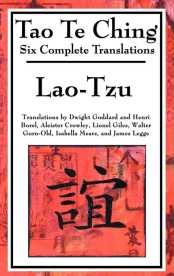 This is the first principle of Taoism, articulated by Lao Tzu:
“The Tao that can be told is not the eternal Tao.”
What does that mean?
If we take Tao to be God or nature, then it means that “…the verbalizations of religions about god or nature cannot teach us the reality of god or nature.”
Could that be the primary principle that we need to teach to every child, and for every adult to use as their guiding light?
Definitely not! It’s too vague; and too philosophically advanced for that purpose.
~~~
Back to Confucius
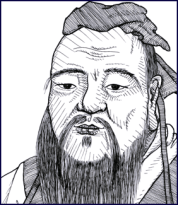 So let us go back to Confucius. While I am waiting to retrieve my Analects of Confucius, I will quote the Encyclopaedia Brittanica, as follows:
“Confucius may have initiated a cultural process known in the West as Confucianism, but he and those who followed him considered themselves part of a tradition, later identified by Chinese historians as the rujia, ‘scholarly tradition,’ that had its origins two millennia previously, when the legendary sages Yao and Shun created a civilized world through moral persuasion.”
According to the Merriam Webster dictionary, moral means: “expressing or teaching a conception of right behaviour”.
 And that might indeed be a good candidate for the first principle that needs to be taught to young children, and which should also be used as the North Star by all adult humans: Do what is right! And “doing what is right” is best understood socially by the Golden Rule:
“Do not treat other individuals any worse than you would want to be treated if your roles were reversed”;
which also means:
“Treat other people at least as well as you would want to be treated if your roles were reversed”.
We could stop there and say: “We have arrived at the First Principle, the guiding light of human behaviour”.
But I suspect this would not be a sustainable position to stop at.
Why not? Becasue we have not considered why, after many generations were raised on the Golden Rule, we nevertheless live in a world in which the Golden Rule is broken and tossed into the gutter by the greedy, callous, and sadistic individuals who rise to the top of political culture and economic life around the world.
Furthermore, we cannot stop there because Confucius was writing his analects to restore, revive or breathe life into an ancient tradition of formalizing and ritualizing moral principles; and in his formalization, there was a central principle of honouring an Emperor, in whom one should invest Divine authority, and Absolute power.
So what happened in subsequent generations to undermine the teaching of the Golden Rule, which was around in ancient China, and which was introduced into Callous and Stoical Roman Europe by the Christians?
And is it possible to enunciate a guiding principle which will not be underminded very quickly by those who do not want a happy life for the greatest number of people?
Today, in Western Europe, I do not think it would be sensible (or morally right!) to advocate an ideology which puts an Emperor at the centre of the maintenance of culture and morality.
Confucius also advocated the following three elements:
(1) worshiping your own ancestors;
(2) honouring your parents and siblings; and
(3) knowing your social place.
Again, I see no real value in resurrecting element (1); nor element (3). But element (2) does seem to be potentially important, especially in the context of an increasingly ageist culture which shows contempt and disregard for the older generations. (We will explore this idea further in a later post.)
~~~
Summary
Neither Lao Tzu nor Confucius seem to offer much in the way of a First Principle for guiding individual humans from childhood to the end of life. Apart from these facts:
- Confucius formulated the Golden Rule, in its negative form: “Never do unto others what you would not like them to do onto you.”
- And it could be claimed that Lao Tzu had a kind of egalitarian element which could have supported a “golden rule”, in his assertion that: “…the root of all things in Heaven and Earth is Tao, which realizes the equal status and rights of all things therein”. (Source: Footnote 1).
Preview of tomorrow’s post
So let us move on to consider what the Buddha “brought to the table”, in the same era as Confucius! (Socrates also lived in the same era, so we will have to consider his views, as expressed through Plato’s representation of Socrates, in his Dialogues!)
Did the Buddha reject the honouring of parents? Did the Buddha provide a useful guiding principle for living a good life in a viable manner?
Continued tomorrow…
… However, the agenda subsequently changed, from the Buddha and Buddhist ideas, to Montaigne and Confucius, in the following post: https://abc-counselling.org/stumbling-upon-michel-de-montaigne-page-3-of-the-page/
Best wishes,
Jim
~~~
Footnote (1) Li, Y.; Cheng, H.; Beeton, R.J.; Sigler, T.J.; Halog, A.B. Sustainability from a Chinese cultural perspective: The implications of harmonious development in environmental management. Environ. Dev. Sustain.; 2016; 18, pp. 679-696. [DOI: https://dx.doi.org/10.1007/s10668-015-9671-9%5D

 ABC Counselling and Psychotherapy, Hebden Bridge